Key takeaways
- For payments made in 2026, a business files Form 1099-NEC for a contractor it paid $2,000 or more, up from $600; the threshold may be adjusted for inflation from 2027.
- Payment apps and online marketplaces file Form 1099-K only when a payee receives more than $20,000 over more than 200 transactions on that platform; card payments have no threshold.
- Payments made by households for personal purposes are not reportable on 1099-NEC, and personal transfers between friends and family do not belong on a 1099-K.
- None of these thresholds changes what is taxable: all side-job income must be reported, whether or not a form arrives.
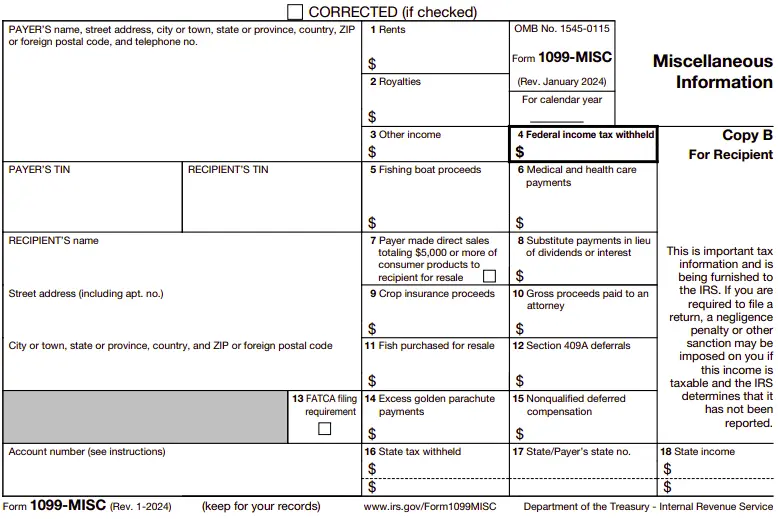

For 2026, a business must send you Form 1099-NEC if it paid you $2,000 or more for services during the year (the threshold was $600 through 2025), and a payment app or online marketplace must send Form 1099-K only if it paid you more than $20,000 over more than 200 transactions. Card payments processed through a card reader are reported with no minimum. These are reporting thresholds, not tax thresholds: all side-job income is taxable and must be reported, whether or not you receive a form.
The 2026 thresholds at a glance
| Form | Who files it | 2026 threshold | Change |
|---|---|---|---|
| 1099-NEC | A business that paid a non-employee for services | $2,000 or more in the year | Was $600; may be adjusted for inflation from 2027 |
| 1099-MISC (rents, prizes, other income) | A business | $2,000 or more | Was $600 |
| 1099-MISC (royalties) | A business | $10 or more | Unchanged |
| 1099-K, payment apps and marketplaces | Third party settlement organizations (PayPal, Venmo, Cash App, Etsy, eBay and similar) | More than $20,000 and more than 200 transactions | Restored by the One, Big, Beautiful Bill Act |
| 1099-K, payment cards | Card processors | No threshold | Unchanged |
Form 1099-NEC: the new $2,000 threshold
The Instructions for Forms 1099-MISC and 1099-NEC (revised 12/2026) state: “For tax years beginning after 2025, the minimum threshold amount for reporting certain payments required to be reported on certain information returns and/or perform backup withholding on those payments increased to $2,000 and may be adjusted for inflation beginning in calendar year 2027.”
In practice, a business files Form 1099-NEC “for each person in the course of your business during the year to whom you have paid at least $2,000” for services performed by someone who is not its employee. The form is due to you and to the IRS by January 31.
What this means for odd jobs:
- A small business that hires you to clean its office windows or help with a move gives you a 1099-NEC only if it paid you $2,000 or more in 2026.
- Households paying for personal services never file one. The instructions are explicit: “Report on Form 1099-MISC or Form 1099-NEC only when payments are made in the course of your trade or business. Personal payments are not reportable.” A neighbor paying you to mow their lawn is a personal payment.
Form 1099-K: back to $20,000 and 200 transactions
Form 1099-K reports payments processed by third parties. After several years of announced but delayed lower thresholds, the One, Big, Beautiful Bill Act (signed July 4, 2025) retroactively restored the original rule. The IRS confirmed in IR-2025-107 that a third party settlement organization does not have to file unless “the gross amount of reportable payment transactions to a payee exceeds $20,000” and the number of transactions exceeds 200.
Points that matter for gig workers:
- Both tests must be met, and they apply per platform. $15,000 on one app and $15,000 on another produces no federal 1099-K.
- Platforms may still send forms below the threshold. The IRS notes they “may send you a Form 1099-K with lower amounts and/or transactions.”
- Card readers are different. If customers pay you directly by credit, debit or gift card through a processor, you get a 1099-K no matter how many payments or how small.
- Some states have lower thresholds for their own 1099-K reporting, so a state form can arrive when the federal test is not met.
Personal payments: friends and family
Money from relatives or friends that is a gift or repays a personal expense should not be on a Form 1099-K. The IRS lists examples such as splitting a meal or a ride, holiday gifts, and a roommate paying their share of rent, and suggests marking these as non-business in the app.
The reverse also holds: tagging a payment for a babysitting job as “friends and family” does not make it a gift. Pay for work is income however the app labels it.
Income is taxable with or without a form
The IRS gig work page is direct: you “must report all income on your tax return, even if you don’t receive Forms 1099.” Thresholds only decide who sends paperwork.
Example: a pet sitter earns $9,000 in 2026: $4,500 through Rover-style app bookings (120 transactions), $3,000 in cash and Zelle from neighbors, and $1,500 from a small business that hired her to look after an office cat. She receives no 1099-K (under $20,000 and 200 transactions), no 1099-NEC (the business paid under $2,000) and nothing from the neighbors. She still reports all $9,000 on Schedule C, subtracts expenses, and pays self-employment tax on the net profit.
If you receive a 1099 with an error
- Personal payments included on a 1099-K: contact the platform for a corrected form; the IRS page “Understanding your Form 1099-K” explains what to do if you cannot get one. Keep records that show which payments were personal.
- Wrong amount or duplicate: ask the issuer for a corrected form.
- Your records are the reference. A simple ledger of every job and payment (see invoices and getting paid) is what lets you match or challenge any form.
If you are the one paying
If you run a small business and hire helpers, 2026 is the first year you file 1099-NEC only for those paid $2,000 or more. Families hiring a sitter or nanny follow different rules: see babysitter and household employee taxes.
For the full picture of what you owe on side income, including estimated taxes and filing thresholds, read do you pay taxes on side jobs?. To price your services with taxes in mind, see the pricing guides and pay by state.
This page summarizes federal reporting rules and is not individual tax advice.
Frequently asked questions
What is the 1099-NEC threshold for 2026?
$2,000. The IRS instructions say that for tax years beginning after 2025 the minimum reporting threshold increased to $2,000 and may be adjusted for inflation beginning in 2027. It was $600 for payments made through 2025.
What is the 1099-K threshold for 2026?
A payment app or marketplace must file Form 1099-K when it pays you more than $20,000 across more than 200 transactions in the year. The One, Big, Beautiful Bill Act restored this older threshold. Payments taken by credit or debit card through a card processor have no minimum.
Will I get a 1099 for Venmo or Zelle payments from friends?
No. Gifts and reimbursements between friends and family, such as splitting a meal or rent, should not be reported on Form 1099-K. Mark them as personal in the app when you can.
Do I have to report income if I did not get a 1099?
Yes. The form is only an information report. You must report all income from side jobs on your return, including cash and app payments below every threshold.
Do families have to send a babysitter a 1099?
No. Form 1099-NEC is required only for payments made in the course of a trade or business, and personal payments are not reportable. A family that employs a household worker may instead owe a Form W-2 under the household employment rules.
Sources and open data
- Instructions for Forms 1099-MISC and 1099-NEC (Rev. 12/2026), Internal Revenue Service
- Understanding your Form 1099-K, Internal Revenue Service
- IRS issues FAQs on Form 1099-K threshold under the One, Big, Beautiful Bill; dollar limit reverts to $20,000 (IR-2025-107), Internal Revenue Service
- Manage taxes for your gig work, Internal Revenue Service
- 26 U.S. Code 6050W, Returns relating to payments made in settlement of payment card and third party network transactions, Legal Information Institute, Cornell Law School
- 26 U.S. Code 6041, Information at source, Legal Information Institute, Cornell Law School