Key takeaways
- Employers may pay workers under 20 as little as $4.25 an hour during their first 90 consecutive calendar days with that employer (29 U.S.C. 206(g), FLSA section 6(g)).
- After 90 days or at age 20, whichever comes first, the federal minimum of $7.25 applies; employers may not displace other workers to hire at the youth wage.
- Full-time student certificates allow 85% of the minimum ($6.1625 an hour at $7.25) in retail, service, agriculture and colleges, capped at 20 hours a week during school (29 U.S.C. 214(b)).
- State law wins when it is higher: 30 states and DC set a minimum above $7.25 in November 2026, up to $18.40 in DC.
- Casual babysitting is exempt from the federal minimum wage, and self-employed teens set their own prices.
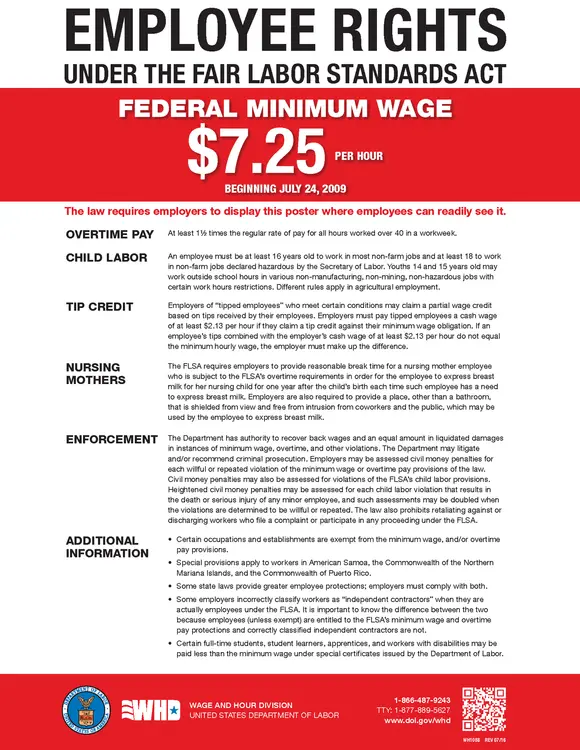

The federal youth minimum wage is $4.25 an hour in 2026. An employer may pay it to workers under 20 during their first 90 consecutive calendar days of employment with that employer, under section 6(g) of the Fair Labor Standards Act (29 U.S.C. 206(g)). After 90 days, or when the worker turns 20, the regular federal minimum of $7.25 applies. A higher state or local minimum overrides the youth rate unless state law makes an exception for young workers, and in November 2026, 30 states and DC set a minimum above $7.25.
The federal rule, word for word
29 U.S.C. 206(g)(1) says that “any employer may pay any employee of such employer, during the first 90 consecutive calendar days after such employee is initially employed by such employer, a wage which is not less than $4.25 an hour.” Paragraph (g)(5) limits it to employees who have “not attained the age of 20 years,” and paragraph (g)(3) bans displacing employees, “including partial displacements such as reduction in hours, wages, or employment benefits,” to hire at the youth wage. A violation of the displacement rule is a violation of 29 U.S.C. 215(a)(3).
The Department of Labor’s Fact Sheet #32 adds the practical points:
- The 90 days are calendar days, not workdays, so a teen who works two Saturdays in a month uses up 30 days of eligibility.
- The rate does not rise with the federal minimum: it has been $4.25 since the 1996 amendments.
- Employers may pay more, and may use the youth wage “unless prohibited by State or local law.”
- Other subminimum programs (full-time students, learners, student-learners) cannot be combined with the youth wage to go below $4.25.
What the youth wage is worth in practice
| Hourly rate | Basis | 18-hour school week | 40-hour summer week |
|---|---|---|---|
| $4.25 | Youth wage, first 90 days | $76.50 | $170.00 |
| $6.1625 | Full-time student certificate (85% of $7.25) | $110.93 | $246.50 |
| $7.25 | Federal minimum | $130.50 | $290.00 |
| $15.00 | Minimum in 7 states, including Florida and Illinois | $270.00 | $600.00 |
| $18.40 | District of Columbia minimum | $331.20 | $736.00 |
The 18 and 40 hour columns match the federal hour limits for 14 and 15 year olds in school and non-school weeks.
Worked example
A 16-year-old starts a summer job on June 15 and works 30 hours a week. The 90-day window runs through September 12. Over those 90 days (12.86 weeks), 30 hours a week is about 386 hours. At $4.25 instead of $7.25, the difference is $3.00 x 386 = about $1,157. In a state with a $15.00 minimum and no youth exception, the youth rate cannot be used at all.
Full-time student certificates (85%)
A separate program in 29 U.S.C. 214(b) lets employers with a Department of Labor certificate pay full-time students not less than 85% of the minimum wage: $6.1625 an hour at $7.25. It applies in retail or service establishments, agriculture, and institutions of higher education employing their own students. Except during vacations, students under a certificate work part time, no more than 20 hours in a workweek (214(b)(4)(A)). 29 CFR 519.2 defines a full-time student as one receiving primarily daytime instruction at a bona fide educational institution, and requires compliance with child labor law, so in retail and service the student must be at least 14.
Tips
Federal law lets employers pay tipped employees, those who customarily receive more than $30 a month in tips, a cash wage of $2.13 an hour with a tip credit of up to $5.12, as long as wages plus tips reach $7.25 (Fact Sheet #15). Teens working as bussers, servers or car wash attendants may be in this situation. Many states set a higher cash wage or ban the tip credit.
State minimums decide most cases
From the Department of Labor state table (updated November 5, 2026), compiled in our pay by state pages:
| Group | States | Minimum |
|---|---|---|
| Highest | District of Columbia, Washington, Connecticut, California | $18.40, $17.13, $16.94, $16.90 |
| $15.00 or more | 18 states and DC | $15.00 to $18.40 |
| Between $7.25 and $15.00 | 12 states, e.g. Michigan $13.73, Virginia $12.77, Ohio $11.00 | $8.75 to $14.42 |
| Federal $7.25 applies | 20 states: 13 at $7.25 (including Texas, Pennsylvania and North Carolina), 5 with no state minimum (Alabama, Louisiana, Mississippi, South Carolina, Tennessee) and 2 with a lower state rate (Georgia, Wyoming, $5.15) | $7.25 |
Some states write their own youth, student or training wage into law, and others do not allow any rate below the adult minimum. The federal $4.25 option only matters in states that defer to the federal minimum or have a youth rate of their own. Check the state page and your state labor department.
Babysitting, odd jobs and the self-employed teen
Two common teen jobs sit outside the minimum wage entirely:
- Casual babysitting is exempt under 29 U.S.C. 213(a)(15). 29 CFR 552.5 defines “casual” as irregular or intermittent work by someone whose vocation is not babysitting.
- Self-employed odd jobs. A teen who mows, walks dogs or shovels snow for their own customers is not an employee, so no minimum wage applies; the price is whatever the customer accepts. LittleJob’s pricing pages turn BLS wages into a fair self-employed rate (see how to price odd jobs and babysitting rates).
The trade-off is tax. Net self-employment earnings of $400 or more in a year generally mean filing a return and paying self-employment tax at 15.3% (IRS). Employees, including those paid the youth wage, generally have Social Security and Medicare withheld instead. See taxes for teens with odd jobs, and consider a Roth IRA for teens for part of the earnings.
This page summarizes federal law and is not legal or tax advice.
Frequently asked questions
What is the minimum wage for a 16-year-old in 2026?
Federally, $7.25 an hour, or as little as $4.25 during the first 90 calendar days with a new employer. Your state minimum applies if it is higher and does not allow a youth rate, which is the case in many states.
Can an employer keep paying $4.25 after 90 days?
No. The 90 days are consecutive calendar days from the first day of work, not days worked, and breaks in service do not extend them. After that, or once the worker turns 20, the full minimum applies.
Do tipped teen workers get a lower wage?
Under federal law, an employer may pay a tipped employee a cash wage of $2.13 an hour if tips bring the total to at least $7.25. Many states set a higher tipped wage or do not allow a tip credit.
Does minimum wage apply to babysitting or neighborhood odd jobs?
Casual babysitting is exempt from the federal minimum wage under 29 U.S.C. 213(a)(15). A teen running their own odd-job business is not an employee, so they set their own price.
Sources and open data
- 29 U.S.C. 206, minimum wage (subsection (g), youth opportunity wage), Legal Information Institute, Cornell Law School
- Fact Sheet #32: Youth Minimum Wage, Fair Labor Standards Act, U.S. Department of Labor, Wage and Hour Division
- 29 U.S.C. 214, employment under special certificates (subsection (b), students), Legal Information Institute, Cornell Law School
- 29 CFR Part 519, Employment of full-time students at subminimum wages, eCFR, National Archives
- Fact Sheet #15: Tipped Employees Under the FLSA, U.S. Department of Labor, Wage and Hour Division
- State Minimum Wage Laws (updated November 5, 2026), U.S. Department of Labor, Wage and Hour Division
- Self-Employment Tax (Social Security and Medicare Taxes), Internal Revenue Service