Key takeaways
- A self-employed mower in the US can charge about $26.89 to $32.17 an hour in 2026: 1.43 x the national median ($18.82) and 75th percentile ($22.52) wage of landscaping and groundskeeping workers (BLS OEWS, May 2025).
- A 21-inch self-propelled mower at 3 mph and 70% field efficiency cuts about 19,400 sq ft an hour; with 15 minutes of trimming and 10 minutes of travel, a 5,000 sq ft lawn takes about 40 minutes.
- That gives about $22 to $25 per cut for 5,000 sq ft, $29 to $33 for 10,000 sq ft and $37 to $44 for one acre with a riding mower, $3 of fuel and wear included.
- Biweekly mowing of taller grass takes longer: about $26 to $30 for 5,000 sq ft. Lawn mowers sent an estimated 9,400 children and young people a year to US emergency departments in 1990 to 2004 (Pediatrics, 2006).
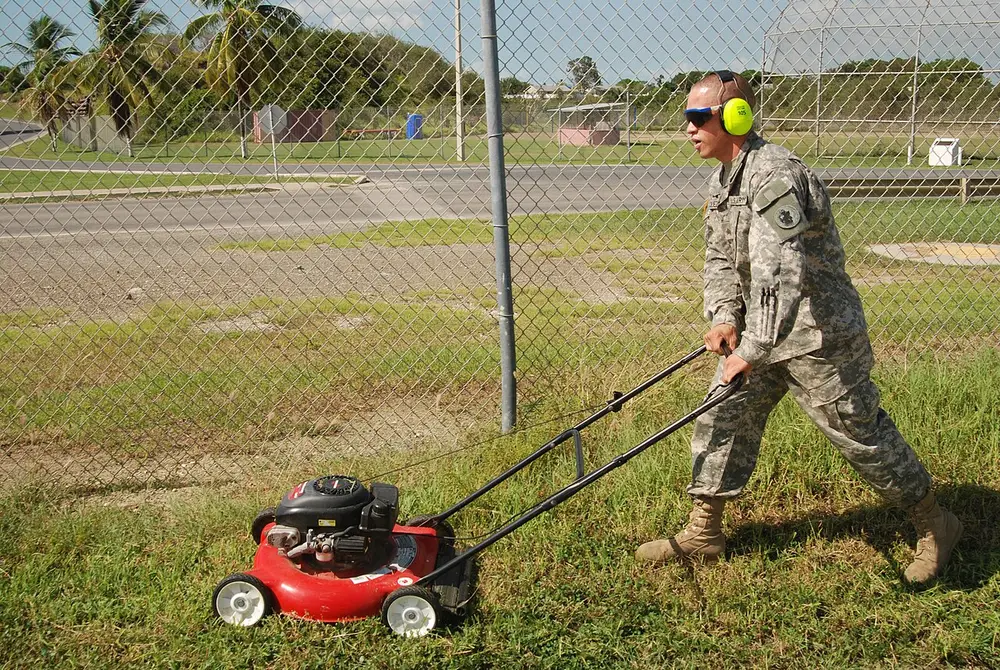

Mowing a typical 5,000 sq ft lawn should cost about $22 to $25 per cut in 2026, about $29 to $33 for 10,000 sq ft and $37 to $44 for one acre with a riding mower. These prices apply a self-employed rate of $26.89 to $32.17 an hour, which is 1.43 times the national median ($18.82) and 75th percentile ($22.52) hourly wage of landscaping and groundskeeping workers in the Bureau of Labor Statistics survey (May 2025), to the time the job actually takes, computed from mower width, speed and field efficiency.
The lawn mowing price calculator runs the same formula with your lawn, mower and state.
The mowing-rate formula
The time to cut a lawn depends on how many square feet the mower covers per hour:
Mowing rate (sq ft per hour) = cutting width (ft) x speed (mph) x 5,280 x field efficiency
Field efficiency is the share of time the blade is cutting new grass: overlap between passes, turns, obstacles and emptying the bag take the rest. The calculator uses 70% by default. For a 21-inch self-propelled mower at 3 mph:
21 / 12 = 1.75 ft; 1.75 x 3 x 5,280 x 0.70 = 19,404 sq ft per hour.
A 5,000 sq ft lawn therefore needs 5,000 / 19,404 x 60 = 15.5 minutes of cutting. Add 15 minutes of trimming, edging and blowing, and the calculator’s default comes to about 30 minutes. At its default rate of $27.00 an hour (1.43 x $18.82, rounded to the nearest 50 cents) plus $3 of fuel and wear, the suggested price is $17, rounded up. Add 10 minutes of travel and it becomes about 40 minutes and $22.
| Mower | Width, speed | Mowing rate at 70% |
|---|---|---|
| Push mower | 21 in, 2.5 mph | 16,170 sq ft/h |
| Self-propelled | 21 in, 3 mph | 19,404 sq ft/h |
| Walk-behind | 30 in, 3 mph | 27,720 sq ft/h |
| Riding mower | 42 in, 5 mph | 64,680 sq ft/h |
Price per cut by lawn size
Assumptions: 70% field efficiency, 15 minutes of trimming and 10 minutes of travel (25 minutes of extras for small and medium lawns, 35 minutes for half an acre and more), $3 of fuel and wear. Low price at $27.00 an hour, high price at $32.17 (1.43 x the national 75th percentile), rounded up to the dollar.
| Lawn area | Mower | Total time | Price per cut |
|---|---|---|---|
| 2,500 sq ft | 21 in self-propelled | 33 min | $18 to $21 |
| 5,000 sq ft | 21 in self-propelled | 40 min | $22 to $25 |
| 7,500 sq ft | 21 in self-propelled | 48 min | $25 to $29 |
| 10,000 sq ft | 21 in self-propelled | 56 min | $29 to $33 |
| 10,000 sq ft | 30 in walk-behind | 47 min | $24 to $29 |
| 21,780 sq ft (1/2 acre) | 42 in riding | 55 min | $28 to $33 |
| 43,560 sq ft (1 acre) | 42 in riding | 75 min | $37 to $44 |
Worked example for 10,000 sq ft with a 21-inch mower: 10,000 / 19,404 = 0.515 hour, or 30.9 minutes, plus 25 minutes = 55.9 minutes. 55.9 / 60 x $27.00 = $25.16, plus $3 = $28.16, rounded up to $29. At $32.17: $29.97 + $3 = $32.97, so $33.
Notice how much equipment matters: a 30-inch mower saves 9 minutes on 10,000 sq ft, and a rider makes an acre cheaper per square foot than a small yard. That is why price per square foot is a poor way to quote small lawns; a minimum charge per visit protects your travel time.
Weekly vs biweekly mowing
Grass left for two weeks is taller, sometimes wet, and needs more overlap, a second pass or more stops to empty the bag. Modeled as 55% field efficiency and 20 minutes of trimming instead of 70% and 15:
| Lawn | Weekly cut | Biweekly cut |
|---|---|---|
| 5,000 sq ft | 40 min, $22 to $25 | 50 min, $26 to $30 |
| 10,000 sq ft | 56 min, $29 to $33 | 69 min, $35 to $41 |
Over a month, weekly mowing of 5,000 sq ft (four cuts) costs the client $88 to $100; biweekly (two cuts) $52 to $60. Offer both and let the client choose.
What lawn mowing pays in the 10 most populous states
BLS May 2025 hourly wages of landscaping and groundskeeping workers in the 10 largest states (Census Bureau, 2025 estimates), suggested hourly rate, and the price of a 5,000 sq ft cut (40.5 minutes plus $3):
| State | Median | 75th pct | Suggested hourly rate | 5,000 sq ft cut |
|---|---|---|---|---|
| California | $21.90 | $24.27 | $31.29 to $34.67 | $25 to $27 |
| Texas | $17.66 | $19.84 | $25.23 to $28.34 | $21 to $23 |
| Florida | $17.84 | $20.99 | $25.49 to $29.99 | $21 to $24 |
| New York | $21.56 | $23.33 | $30.80 to $33.33 | $24 to $26 |
| Pennsylvania | $18.99 | $22.40 | $27.13 to $32.00 | $22 to $25 |
| Illinois | $21.05 | $22.58 | $30.07 to $32.26 | $24 to $25 |
| Ohio | $18.38 | $21.94 | $26.26 to $31.34 | $21 to $25 |
| Georgia | $18.25 | $21.33 | $26.07 to $30.47 | $21 to $24 |
| North Carolina | $18.22 | $21.40 | $26.03 to $30.57 | $21 to $24 |
| Michigan | $18.33 | $22.25 | $26.19 to $31.79 | $21 to $25 |
The highest state medians are in the District of Columbia ($23.46), Massachusetts ($23.40) and Alaska ($22.93); the lowest in Mississippi ($15.21) and West Virginia ($15.50). All states are on the pay by state page. The methodology page explains the 1.43 factor: wages are 70.0% of private employer compensation costs (BLS Employer Costs for Employee Compensation, June 2026).
Mower safety
Mowers cause serious injuries, often to bystanders. Using the CPSC’s National Electronic Injury Surveillance System (NEISS), a study in Pediatrics estimated 140,700 lawn mower injuries to children and young people aged 20 and under treated in US emergency departments from 1990 to 2004, about 9,400 a year. Lacerations were the most common injury (41.2%), and the hand or finger the most injured body region (34.6%). NEISS is public: anyone can query current estimates with the NEISS query system.
Basic rules from the CPSC’s mower safety tips and common sense:
- Pick up stones, toys and sticks before mowing; the blade throws them.
- Keep children and pets away, and never mow in reverse without looking behind you.
- Wear closed shoes with good grip, long pants and hearing and eye protection.
- Stop the engine and wait for the blade to stop before clearing the chute or adjusting anything.
- Never refuel a hot engine.
Teens, the law and taxes
For employers covered by federal child labor law, 14 and 15 year olds may not operate power-driven lawn mowers, trimmers or edgers (29 CFR 570.33(e)), although they may do grounds maintenance with hand tools (29 CFR 570.34(h)). A teen mowing neighbors’ lawns on their own is generally outside those rules, but state laws can be stricter. Read jobs for 14 and 15 year olds.
Mowing income is self-employment income; self-employment tax applies once net earnings reach $400 in a year, and driving between lawns is deductible with the mileage deduction for side gigs. This is general information, not legal or tax advice.
Mistakes to avoid
- Quoting per square foot for small lawns and losing money on travel.
- Charging biweekly cuts at the weekly price.
- Forgetting fuel, blade sharpening and trimmer line in the price.
- Mowing without clearing the lawn of objects first.
Frequently asked questions
How much should I charge to mow a lawn in 2026?
About $22 to $25 per cut for a typical 5,000 sq ft lawn at the national level, based on 1.43 times the BLS median and 75th percentile wages of landscaping workers ($26.89 to $32.17 an hour) and about 40 minutes of mowing, trimming and travel.
How much should a teenager charge to mow a lawn?
The work and the time are the same, so the same method applies. A beginner with a push mower can start near the low end, about $22 for 5,000 sq ft, and move up with experience and regular clients.
How long does it take to mow 1 acre?
With a 42-inch riding mower at 5 mph and 70% field efficiency, about 40 minutes of cutting (64,680 sq ft per hour). With a 21-inch push mower at 2.5 mph, about 2 hours 40 minutes.
Should biweekly mowing cost more than weekly?
Yes. Grass left two weeks is taller and wetter, so you overlap more, empty the bag more often and trim longer. Lowering field efficiency from 70% to 55% and adding 5 minutes of trimming raises a 5,000 sq ft cut from about 40 to 50 minutes.
Can a 14-year-old use a power mower for a job?
For employers covered by federal child labor law, 14 and 15 year olds may not operate power-driven lawn mowers (29 CFR 570.33(e)). Federal rules do not cover casual chores around private homes, but state rules and safety still apply.
Sources and open data
- Occupational Employment and Wage Statistics (OEWS), May 2025 estimates, U.S. Bureau of Labor Statistics
- Employer Costs for Employee Compensation, June 2026, U.S. Bureau of Labor Statistics
- Grounds Maintenance Workers, Occupational Outlook Handbook, U.S. Bureau of Labor Statistics
- Vollman D, Smith GA. Epidemiology of lawn-mower-related injuries to children in the United States, 1990-2004. Pediatrics 2006;118(2):e273-8, PubMed
- CPSC Issues Safety Tips For Rotary Power Mowers, U.S. Consumer Product Safety Commission
- NEISS On-Line Query System (National Electronic Injury Surveillance System), U.S. Consumer Product Safety Commission
- 29 CFR 570.33, Occupations that are prohibited to minors 14 and 15 years of age, Electronic Code of Federal Regulations
- State Population Totals and Components of Change: 2020-2025, U.S. Census Bureau