Key takeaways
- LittleJob suggests $34.06 to $43.00 an hour for roofline light installation in 2026, based on BLS wages of general maintenance and repair workers ($23.84 median, $30.10 at the 75th percentile, May 2025) x 1.43.
- Ground-level work such as shrubs and porch rails fits the landscaping rate: $26.89 to $32.17 an hour.
- A 120-foot single-story roofline (about 1.7 hours) comes to about $58 to $73, or roughly 48 to 61 cents per foot, plus takedown later.
- CPSC estimates about 14,800 people were treated in emergency departments for holiday decorating injuries in the 2022 season, over 40% of them from falls.
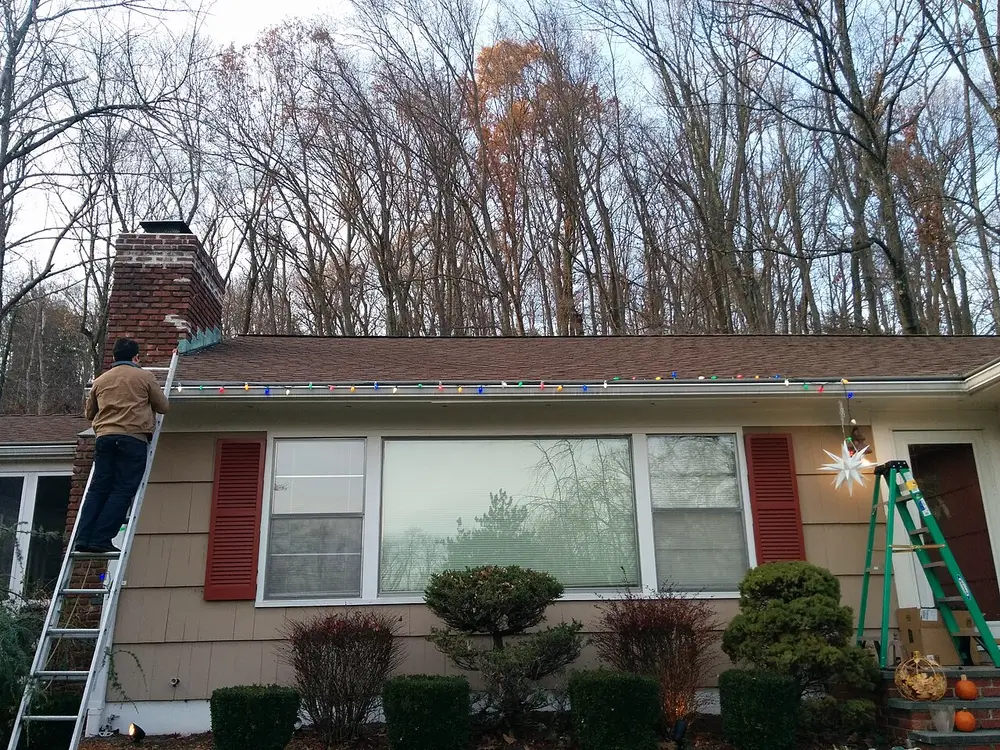

Hanging holiday lights on a roofline is worth about $34 to $43 an hour in 2026 for a self-employed installer, which puts a 120-foot single-story roofline at about $58 to $73 for installation, roughly 48 to 61 cents per foot when the customer supplies the lights. LittleJob bases this on the BLS wage of general maintenance and repair workers ($23.84 median, $30.10 at the 75th percentile, May 2025) multiplied by 1.43. Ground-level decorating fits the lower landscaping rate of $26.89 to $32.17 an hour.
Which wage to use: two proxies
No BLS occupation is called “holiday light installer.” Two occupations in LittleJob’s dataset bracket the work, and the honest answer is to use both:
- General maintenance and repair workers (code 49-9071) climb ladders, work at the roofline and handle electrical connections and fixtures. That is the risky, skilled part of the job: extension ladders, gutters, clips, timers, outdoor outlets. LittleJob uses this occupation for roofline and second-story work.
- Landscaping and groundskeeping workers (code 37-3011) do outdoor work on the ground, around shrubs and trees. LittleJob uses it for ground-level work: wrapping bushes, porch rails, stake lights and yard figures.
| Basis | Median | 75th pct | Self-employed range (x1.43) |
|---|---|---|---|
| Maintenance and repair workers (roofline) | $23.84 | $30.10 | $34.06 to $43.00 |
| Landscaping workers (ground level) | $18.82 | $22.52 | $26.89 to $32.17 |
The 1.43 factor: wages are 70.0% of private employer compensation costs (BLS, June 2026), and 1 / 0.70 = 1.43. See the methodology page.
Prices per job, with time assumptions
LittleJob planning assumptions: one installer with an extension ladder hangs about 100 feet of roofline per hour including ladder moves on a single-story house, plus 30 minutes for layout, connections and testing. Two-story work is slower (about 75 feet per hour) and needs a second person to hold the ladder.
| Job | Time | Low | High |
|---|---|---|---|
| Shrubs and porch rail, ground level (landscaping rate) | 1 hour | $26.89 | $32.17 |
| Single-story roofline, 120 feet | 1.7 hours | $57.90 | $73.10 |
| Takedown and coiling, same house | 0.85 hour | $28.95 | $36.55 |
| Two-story roofline, 150 feet, installer + ground helper | 2.5 hours x 2 people | $152.38 | $187.93 |
Arithmetic for the single-story row: 120 feet / 100 feet per hour = 1.2 hours, plus 0.5 hour of setup = 1.7 hours; 1.7 x $34.06 = $57.90 and 1.7 x $43.00 = $73.10. Divided by 120 feet: $0.48 to $0.61 per foot. The two-story row pays the installer at the maintenance rate and the helper at the landscaping rate: 2.5 x ($34.06 + $26.89) = $152.38.
If you supply the lights, clips and timers, bill them separately at cost plus a small handling margin, and say who owns them after the season.
Worked example with the price calculator
For the single-story house, using the odd job price calculator:
- Rate $38 an hour, 1.7 hours on the job, 20 minutes of travel round trip.
- Labor: $38 x 2.03 = $77.27.
- Vehicle: 8 miles x $0.76 (IRS business rate from July 1, 2026) = $6.08.
- Supplies (gutter clips, zip ties): $15.
- Total $98.35, quoted at $100. Offer the January takedown at the same time, for example $45, and book both dates now.
A minimum charge of about $50 per visit keeps small jobs worth the drive.
What installers can charge in the 10 most populous states
Maintenance and repair worker wages by state (BLS OEWS, May 2025) and the suggested roofline rate:
| State | Median | 75th pct | Suggested hourly rate |
|---|---|---|---|
| California | $27.41 | $34.24 | $39.16 to $48.91 |
| Texas | $22.44 | $28.45 | $32.06 to $40.64 |
| Florida | $22.15 | $27.18 | $31.64 to $38.83 |
| New York | $27.79 | $33.48 | $39.70 to $47.83 |
| Pennsylvania | $23.70 | $29.70 | $33.86 to $42.43 |
| Illinois | $27.27 | $33.02 | $38.96 to $47.17 |
| Ohio | $25.68 | $30.65 | $36.69 to $43.79 |
| Georgia | $22.92 | $28.85 | $32.74 to $41.21 |
| North Carolina | $23.03 | $28.63 | $32.90 to $40.90 |
| Michigan | $22.87 | $28.60 | $32.67 to $40.86 |
For ground-level work, use the landscaping figures on each state page. All states: pay by state.
Ladder safety: the part that matters most
The Consumer Product Safety Commission estimates that in the 2022 holiday season (November 1, 2021 to January 31, 2022), about 14,800 people were treated in hospital emergency departments for decorating-related injuries, about 160 a day, and over 40% of the incidents involved falls. These estimates come from NEISS, the CPSC’s injury surveillance system, whose data and query builder are public and free to use.
OSHA’s portable ladder rules for workers are a good standard for paid installers:
- Keep 3 points of contact (two hands and a foot, or two feet and a hand) and face the ladder.
- Set the angle with the 1-in-4 rule: the base sits a quarter of the working length away from the wall.
- Extend the ladder at least 3 feet above the roof edge you step onto, and do not stand on the top three rungs of an extension ladder.
- Look for overhead power lines and avoid metal ladders near them.
- Inspect the ladder before use and never set it on boxes or uneven ground.
Add your own rules: no roof work in rain, ice or wind, and no roof work alone. Check that light strings and extension cords are rated for outdoor use and that connections stay off the ground. More in safety for odd jobs. Falls are also why liability insurance is worth pricing in; see business license and insurance. The same ladder skills sell in fall as gutter cleaning.
Teens and taxes
Teens can do ground-level decorating; keep roof and tall-ladder work for adults, and read hazardous jobs banned under 18. Installation income is self-employment income: once net earnings reach $400 a year you owe self-employment tax of 15.3%. See do you pay taxes on side jobs and the self-employment tax calculator. This page is general information, not tax advice.
Frequently asked questions
How much should I charge to hang Christmas lights?
About $34 to $43 an hour for roofline work in 2026, based on BLS maintenance and repair wages adjusted for self-employment. For a 120-foot single-story roofline that is roughly $58 to $73 for installation, plus a separate takedown fee.
Do you charge per foot for Christmas light installation?
Per-foot pricing is easy to quote: about 48 to 61 cents per foot of roofline for a single-story house at LittleJob rates, if the customer supplies the lights. Raise it for two-story homes, steep roofs or when you supply the lights and clips.
How much should I charge to take down Christmas lights?
Takedown usually takes about half the installation time. For a 120-foot single-story roofline, that is roughly $29 to $37.
Is it safe for teens to hang holiday lights on a roof?
Ground-level decorating is a reasonable teen job, but roof and tall ladder work is where most decorating injuries happen, and federal child labor rules restrict some roofing and height work for minors. Keep teens on the ground.
Sources and open data
- Occupational Employment and Wage Statistics (OEWS), May 2025 estimates, U.S. Bureau of Labor Statistics
- Employer Costs for Employee Compensation, June 2026, U.S. Bureau of Labor Statistics
- Make it a 'Home Safe Home' for the Holidays (2024 news release), U.S. Consumer Product Safety Commission
- National Electronic Injury Surveillance System (NEISS), U.S. Consumer Product Safety Commission
- Portable Ladder Safety QuickCard, Occupational Safety and Health Administration
- Standard mileage rates, Internal Revenue Service